Monday, June 13, 2011

The Young Elephant from Africa

The Young African Elephant


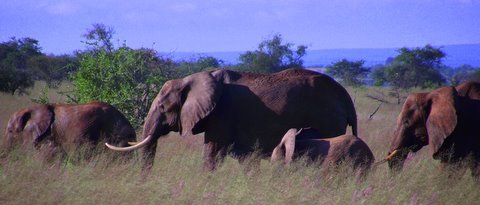
When a baby elephant (weighing from a hundred to a hundred and fifty kilogram’s and standing a meter and a half high) is born in the African bush, the entire herd of elephants greets his arrival with joyful trumpeting.


For the first few days, although the baby elephant is able to walk, the young elephant prefers to stay hidden under his mother’s stomach or hind legs from where he can reach back with his trunk to suckle from one of her teats.

If the baby elephant is reluctant  to stir when the herd begins to move, all the mother elephant needs is some prodding from his mother’s trunk. Sometimes, however whenthe baby elephant becomes unruly; then his mother pricks him with her tusks and pushes him with her head. If that doesn’t succeed, the baby elephant gets a spanking with his mothers trunk, of course. These are just the simple day today lessons a young elephant needs to learn when the days go by.

During their journeys, the young elephant winds his trunk and his mother’s tail, not from fear of getting lost, but to enable him to keep pace.  You fidn that during the elphant train, a herd of elephants can walkmiles and miles of land looking for water and fresh grass as well.

Friendly rivalry among young elephants of the same age, who meet when the herds stop at water holes, is a natural outlet for their exuberance. The outcome of this ‘skirmish’ is a spectacular fall into the water.
The elephant trumpeting to a mother summons the heard. Her threatening tusks and swinging trunk ward off an attack on her baby elephant by any hungry predator. The baby elephant find protection by hiding under her mothers big body


The elephants
Africa blessed with the most beautiful animals in the world, the African savannah has also produced many of the world’s dangerous animals ever seen. Elephants are the largest amazing land mammals in the world.
The African elephant tops part of the list of the most dangerous animal on earth. In many parts of the world, there are dark to brown elephants, gray to black elephants, red to pink elephants depending on the eyes of the beholder and the great white or albino elephants as people call these dangerous beautiful elephants. These dangerous species of elephant live in the jungles of Africa and Asia.
 
The African Elephant: the top ten most dangerous animal
The African Bush Elephant or the dangerous African Savanna Elephant (Loxodonta africana) is larger of than two species of African elephant. The great Savannah elephant and the African Forest Elephant have usually been classified as a single species, known as the beautiful dangerous African Elephant. The largest African elephant ever recorded was 4 meters at the shoulder and weighed ten tonnes

While most of the dangerous elephant animal attacks take place in many of the African countries from south of the Sahara desert to South Africa with an estimated over 500000 number of African elephants in the world,
Elephants attack without warnings; they can kill other animals and also come to rescue other animals when they are in danger too. There are many cases where elephants have killed their trainer and zoo keepers too. Farmers are not spared while those of an African Safari also get attacked my giant African elephants too.
 
The Asian Elephant
Sri Lanka, India, Pakistan, Bangladesh, Bhutan, Myanmar, Thailand, Vietnam, Cambodia, Laos and China make the total number of the Asian elephant (Elephas maximus) to be around 50,000 elephants in Asia. The elephants are responsible for over 400 fatalities every year in different parts of the world. Elephants are dangerous animals and should not be tampered with.
The dangerous Asian elephants are some of the biggest elephants in the world located in may parts of the Asian tropical forests. The gray Asian elephant coloration provides them with a very good elephant habitat. These dangerous elephants can use their six major muscles which are extended to the truck and reach the ground to get hold of objects, grab all the elephant food on top of trees and on the ground as wee.
 
These clever dangerous elephants find pleasure when they squirt gallons of water over their backs or into their mouths, or blow their favourite elephant dirt onto their backs during dust baths. What is always a result of these dirt baths? These giant elephants come out with a different outlook. White elephants, red elephants, brown elephants, black elephants depending on the type of bath the elephant has taken.

The elephant Loss of habitat

The Asian Elephants have caused and are still causing great damage to crops of many farmers. Elephants attacks cases in Asia are still many where people have been killed with dangerous elephant who have gone on rampage. Asian Males elephants in musth are responsible for many deadly elephant attacks.
The Asian Elephants is very important to the cultures and religions of many Asian countries such as India, Sri Lanka, Laos, Malaysia, Nepal, Bangladesh, and southern China, Myanmar (Burma), Indonesia, Thailand, Cambodia, and Vietnam.
 
in most of their range, which inspires support for habitat protection measures, continued studies about elephants and their conservation needs, and efforts to mitigate conflicts between elephants and people. Despite the fact the Asian elephants have been tamed with expert elephant trainers for decades as beasts of burden with dates ranging as far as 4,000 years these Asian elephants had to do the elephant job which was mainly hauling lumber, elephant ware fare, transportation and for prestige. While the female Asian elephants were not blessed with beautiful dangerous tusks, it’s the dangerous male elephant which is responsible for many of the dangerous attacks in Asia.
Decades of elephant hunting and the dangerous elephant habitat destruction has diminished the huge number of the Asian elephants. The Asian male elephants are being attacked and killed for their huge tusks
Elephant facts and figures
Elephants all over the world are unpredictable animals, and have been known to kill zoo keepers, their owners and many who have been with them for as long as 15 years. The fact remains that even the tamest of elephants can attack without warning. Remember its an elephant jungle out there! Elephants have got the biggest brains and apart from man, elephants are some of the most intelligent animals in the world and regarded as one of the world's most dangerous animals.
 

Elephant Attacks:

As far as elephant attacks are concerned, there are around 300-500 elephant related attacks and deaths a year.
Elephant habitat: Africa and India.
Method of dispatch: The elephant average size weighs over 6 tons. Elephants trample and gore using their dangerous sharp tusks. Elephants cause a lot of damage to crops and property.

How to avoid dangerous elephant attacks:


Inorder to avoid any elephant attacks you should walk careful when you are in an elephant habitat, be wise don’t startle an elephant when you see one as any unwanted and unfriendly moves will induce the giant elephant to charge.
 
If the elephant seems to want to finish you, make some noise and run for your life. If there is a tall strong tree climb it as you keeep on shouting for help as well. Whileon an African Safari and your arein your car and the elephant is near, there are two ways. wait still without any movement or sound the horn of your vehicle while in the jungle or steadily back off. All in all just stay away from these dangerous animals because when elephants attack they will almost leave you dead


You have read this article african elephant / elephant attacks / elephant baby / elephant pictures / elephant train / elephant tusks / elephant videos with the title . You can bookmark this page URL https://kevinnicollecolvin.blogspot.com/2011/06/the-young-elephant-from-africa.html. Thanks!

The Baby Indian Elephant

The Young

Indian Elephant

Less than a year old, this baby elephant has left his mothers side to pursue some heroism. Like cats and dogs, the baby elephant expresses his enthusiasm  with his tail. The desperate trumpeting of a mother elephant summons the herd. Her Docile as a puppy, this domesticated Indian elephant with its smiling  tusks and swinging trunk ward off an attack on her stands patiently while he is painted with characteristic decorations then he will take part in a traditional parade with its mother. 

These are just some of the Asia elephant privillages that they get unlike the Africa forest elephants which are not easily tamed are are some of the most dangerous animals in the Africa Savannah habitat. Is the Indian elephant also known as the Asian elephant? Well most of the elephants from Asia are found in India where you have the largest number of Asian or Indian elephant in the world or in the wild. Many of the Asian or India elephant such species are also found in may of the Asian natural habitat as well. some of the countries where the Asian or India elephant are found are in countries such as Bangladesh, Bhutan, Borneo Cambodia, China, Laos, mainland of Malaysia, Myanmar, Nepal, Thailand, Sumatra and Vietnam.

Introducing the Indian Elephant

The Indian elephant - also known as the Asian elephant, Asiatic elephant, or Elephas maximus indicus - is the largest mammal native to the Indian subcontinent. The Asia elephant is in fact respected in the Asia continent despite the Asian elephants being considered as endangered animals, the plight of the Asia elephants is still at stake. The carnage and killing and illegal elephant poaching is still going on not only for its body parts but as a way of reducing the clashes between man a animal in many of the beautiful Asian forest which need to make way for development, agricultural and land use in order to accommodate the ever growing Asian population which is growing at speeds the Asian elephants cannot compete with as far as the elephant natural feeding and breeding habitat is concerned.

Which elephants are the biggest? Is it the African elephants or the Asian elephants. As far as the animal facts about the Asia elephants is concerned, the biggest elephants are about 6.4 metres long, perhaps 3 metres from ground to shoulder and another 50 cm taller at the head. The biggest elephants may tip the scales - or perhaps crush them - at just under 5,000kg for a fully grown elephant. 


One amazing fact about the Asia elephants is that a small adults Asian elephants weigh perhaps half that of an adult Asia elephant; a calf's birth or a baby elephant when it is born might  weigh about  50kg to 150kg. Did you know that the males Asian elephants are typically larger than females elephants. Are there any reasons as to what the Asian male elephants are larger as compared to the female Asia elephants? 

Is it because the Asia male elephants have horns while the female elephants do not have horns and there by giving the mare reasons that the male Asian elephants use all their energy to process the tusks they possess such  that hindering them to grow bigger in size. Well as far as facts about the size of the male Asia elephants is concerned, I guess nature has more to do with these amazing creatures of Asia.

The beautiful Asia elephants skin
Are Asia elephants different from other elephant species in the wild as far as the elephant's skin is concerned? Well if there are red elephants white elephants and black elephants, what are the actual facts about a bay Asian elephant as far as the skin of the elephant is concerned? The Asian elephant skin may be brown or grey, but you will find that some Asia elephants are having some amazing colors of some pink areas mainly on the head. What is so amazing about the Asia elephants that most people who go to Africa on an elephant animal safari don't know? One amazing fact about Asia elephants is that the Asian elephant is perhaps best known for its prehensile trunk. The beautiful amazing dangerous Asian elephant has a very long nose and upper lip with an amazing variety of uses. 


You will be amazed as to how the Asian elephant can sniff the path used by the Asian big cats notably the beautiful Asian endangered tigers and the endangered spotted and snow leopards as well. Having a bigger body as far as the elephant is concerned does not really affect the elephant's movement in the deep dangerous forests of Asia. This is because the Asia elephants have thick legs rest that rest on pads to absorb the animal's weight.

Elephant dentistry is remarkable

Animals need teeth to chew and to cut or tear whatever food they are eating. The Asian big cats have powerful teeth to catch their prey and as far as the Asian elephants re concerned, these beautiful dangerous animals use their teeth to crush and much grass, roots twigs and fruits that they find in their natural habitat. When it comes to eating elephants also have teeth and one amazing fact about the Asian elephants teeth as well is that very large elephant teeth develop, but the elephant's teeth wears down the front ones. 

These elephant teeth are replaced from the rear, until no more remain. At this point  only reached by a quite aged elephant and it will be unable to eat properly, and so it will starve as any other living organism. One funny amazing fact about these beautiful creatures of the Asian continent is that the male Indian elephants develop tusks by growing a pair of incisors by about 17cm per year.

As far as the size of an Asia elephant family r elephant heard is concerned, there are many elements which has been affecting  the elephants family as far as Asia is concerned. Many years ago, the Asia elephants used to roam far and wide in the Asia continent. Now days with the demarcation of land and national boundaries, these beautiful endangered dangerous animals of Asia  are only located on protected natural habitat and even in these animal sanctuaries  the elephant herds are only limited with many of the male Asian elephants being illegally poached due to their prized tusks. 

The sheer size of an elephant hear or family which are remaining in the Asian wild forests are always composed of related female elephants that form herds. These female elephants often do consist of about twenty elephants, including a few adult elephants and some cute dependent children elephants as well. 

Do the baby elephants move and start their own families as far as the right of passage to the Asian elephants is concerned, in the wild, the young male lions are normally chased away when they start to show dominance over the other small lions in the pride and as far as the  young Asian male elephants are concerned, the male elephants  leave at about age 14, and may be solitary, travel with other males for short times, or join a matriarch's herd when he has an opportunity to breed. Do you think the baby Asian elephant will have a chance to survive in this age where the elephant tusk trade is heating the market from all angles and people will go miles in order to acquire these elephant tusks by hook or crook? Well all the help elephants can be given in terms of elephant conservation projects in Asia or any elephant awareness programs which educate the people about the light of the endangered Asian elephants will help solve the already plight of the endangered Asian elephants and many of the endangered animals as well. Its not just saving the Asian elephants which is of importance. Elephants do belong to this earth and are part of our natural ecosystem. 

Elephants have rights as humans have but many of us have found ways in exploiting these beautiful animals in such a way that with little ways of knowing how they react, we are forced to see unforeseen dangerous elephant attacks within these regions and these beautiful elephants are some of the most dangerous animals in Asia. Its always in the news. Do we need to learn from experience or is it just more information which people need. It could be the culture, invested interests    or just the fact that we are still yet to learn.

Only a dominant male Asian elephant is "permitted" to breed, so size and aggressiveness are important traits as far as the continuation of the Asian elephant generation is concerned. To come to think of it, how many male Asian elephants are remaining in the wild if they have all not been captured and helping in the timber industry? Are there that many male Asian elephants to keep the endangered Asian elephants surviving in the wild? My good guess is that with very few male Asian elephants remaining in Asian elephant habitat, many female elephants when they are on heat are not able to get good male elephants who can be able to produce elephants which are not within the linage as in breading of elephants just like the endangered cheetah which has proved to be difficult even to breed in captivity has really puzzled may animal lovers who would have loved to keep these beautiful animals as pets. 

With all the taming of the Asian elephants and possession as a right of heritage to many of the Asian society, these beautiful elephants need to be in the wild where they can fully grow and enjoy their natural habitat just like and other wild animal born to be wild and free. If all the African elephants could hear their cousins in Asia, these beautiful dangerous elephants would have come to the rescue of the Asian elephants whose numbers are going down as compared to the African elephants as well which also doesn't a very good story to tell with many of the civil wars and internal civil strife displacing people who end up in many of the African national parks and game reserves to seek refuge  and as a result, many of the exotic wild animals as well end up being trapped for food and a few hunt these animals to sell as pets or to any buyers who could help them make quick money in such dangerous precarious situations which seem to have no end as far as civility in many of the newly democratic states are concerned.

While many animals have greater communication skills which are more powerful than humans, there are some interesting facts about the Asian elephants that they can hear the Tsunami coming or if there is an earth quack  As far as facts about the elephants communication is concerned  elephants can communicate over long distances by calling at very low frequencies - often below the lowest notes humans can hear. This seems to be the reason as to how they can co-ordinate arriving at a destination, such as a water source at the same time.

Elephants are vegetarians


Elephants are vegetarians and all elephants eat grass, leaves, bark, fruits and vegetables. If the grass is short, an elephant will scrape together a pile using its feet, then pick up the bale. The back of a tree is shredded from a branch in the same way that people eat corn on the cob. Symbiotic bacteria in an elephant's intestines help it to digest its daily diet of 150kg of vegetation and is washed down with over 100 litres of water.

Uses of The Elephant trunk


The elephant trunk has many uses. It sniffs out food sources, collects grass, holds foods, serves as a "nose" for breathing, tosses dust or sprays water for skin care, acts as a hose for drinking and helps in trumpeting.

How to Distinguish Indian Elephants from African Elephants

How does one distinguish an Indian elephant from an African elephant? The general differences are:

The ears of an Indian elephant are smaller and rounder than those of an African elephant
An Indian elephant's back does not slope down as sharply
The highest point of an Indian elephant is the head, but an African elephant's shoulder is the highest location
An Indian elephant's trunk has only one "finger" but an African elephant's trunk has two "fingers"
An Indian elephant has four nails on the hind foot where an African elephant only has three
On average, an Indian elephant is not quite as large as an African elephant - although accounting for age or gender may outweigh the "average" size difference
Another difference is that a female Indian elephant does not grow tusks. Males of both species do grow the extended incisor, as do female African elephants.
It almost goes without saying that a tourist has an additional clue: "If you find one in Africa, it is probably an African elephant; if in India, it is probably an Asian elephant."

Are Indian Elephants Endangered?

As far as endangered animals are concerned, all Asian elephants are considered endangered and are in the endangered species list. Few animals can threaten Indian elephants. Males are dangerous individuals, and herds will circle their young to protect the baby elephants from any attacks from other animals. However, the Indian elephant is indeed on "Appendix I of the Convention on International Trade in Endangered Species and are considered endangered by the International Union for the Conservation of Nature", according to Animal Diversity.
Human poaching is the most publicized danger. The tusks continue to be valued for ivory - whether or not most of the world has banned trading in this commodity. Since only male Indian elephants have tusks, the females have not faced the same risks as their African cousins. Nonetheless, sometimes the male/female ratio is an unsustainable one to one hundred (1:100).
In India, perhaps the worst danger to the elephant is human encroachment on existing habitats. The human need for farmland cannot be questioned; but elephants may be paying the price. So are the unfortunate farmers who are trampled - several hundred die annually in human/elephant confrontations.
In addition, the new farmland is precisely where elephants - with their proverbial long memories - had been grazing for food. When they find that nutritious vegetables have replaced grass and trees, the elephants will gladly eat the farmers' crops. Predictably, farmers often retaliate with violence.
Organizations such as the World Wildlife Fund and government agencies in India are actively trying to protect the Indian elephant population, currently estimated to be 28,000 to 42,000 in the wild. In September 2010, Indian Environment minister Jairam Ramesh announced that the elephant is a "national heritage animal" to be accorded the same protection "...as bestowed upon the mighty tiger".
Some 3,500 elephants are "working" in India. Around the world, elephants grace zoos and circuses. Historic cultural influences in India may also enhance the elephants' chance of survival. The elephant is one of the "nine jewels" ("navratnas") which surfaced as deva and asura (gods and demons) searched for the elixir of life in the oceans. Hopefully the religious requirement to protect this jewel of an animal will indeed help the Indian elephant survive.


Those who read about elephants also liked

  1. The Leopards of the African Savannah Lands
  2. Beautiful Cheetahs of Africa Animal Safari
  3. Twiga, the tallest giraffe in the world
  4. Baby Lions and the King of the African Jungle
  5. Cheetahs, Big Cats tree Climbers


You have read this article an elephant / animal pictures / asia / asian animals / baby elephants / dangerous wild animals / elephant conservation / endangered elephant / indian animals / indian culture / wild animals with the title . You can bookmark this page URL https://kevinnicollecolvin.blogspot.com/2011/06/the-baby-indian-elephant.html. Thanks!